Give your agent a local source layer.
Uoink runs a local Model Context Protocol (MCP) server on your machine. The stdio path gives Claude Desktop, Cursor, and Cline the 14 curated everyday tools to capture, search, cite, classify, and write from your corpus. The local HTTP endpoint exposes the full 64-tool registry.





Stdio and HTTP transports.
Configure stdio connections in your agent client, or query the programmatic HTTP endpoint.
Uoink runs a local Model Context Protocol (MCP) server. The stdio transport connects as a local subprocess and exposes the 14 curated everyday tools. The local HTTP (SSE) endpoint exposes the full 64-tool registry.
HTTP (SSE) Transport Details
Endpoint URL: http://localhost:5179/mcp/v1
Authentication: Include the header X-Uoink-Token on every request.
Token Location: Read the token string from the local file %LOCALAPPDATA%\Uoink\token.txt (or ~/Library/Application Support/Uoink/token.txt on macOS).
Claude Desktop
{
  "mcpServers": {
    "uoink": {
      "command": "C:\\Users\\YOUR_USERNAME\\AppData\\Local\\Uoink\\python\\python.exe",
      "args": [
        "C:\\Users\\YOUR_USERNAME\\AppData\\Local\\Uoink\\uoink_mcp.py"
      ]
    }
  }
}
Cursor
{
  "mcpServers": {
    "uoink": {
      "command": "C:\\Users\\YOUR_USERNAME\\AppData\\Local\\Uoink\\python\\python.exe",
      "args": [
        "C:\\Users\\YOUR_USERNAME\\AppData\\Local\\Uoink\\uoink_mcp.py"
      ]
    }
  }
}
Cline / Continue
{
  "name": "uoink",
  "transport": "stdio",
  "command": "C:\\Users\\YOUR_USERNAME\\AppData\\Local\\Uoink\\python\\python.exe",
  "args": [
    "C:\\Users\\YOUR_USERNAME\\AppData\\Local\\Uoink\\uoink_mcp.py"
  ]
}Ask Cursor to research a launch video from source.
Uoink these three competitor videos, classify their hooks, and write a launch memo with citations.
The agent captures each source, polls jobs, fetches corpora, classifies hooks, searches your library, then writes the memo into your workspace.
uoink_video(url_1)
uoink_video(url_2)
uoink_video(url_3)
get_job_status(job_id)
get_uoink_corpus(corpus_id)
classify_hook(corpus_id)
search_uoinks("launch narrative")
write_blog(corpus_set)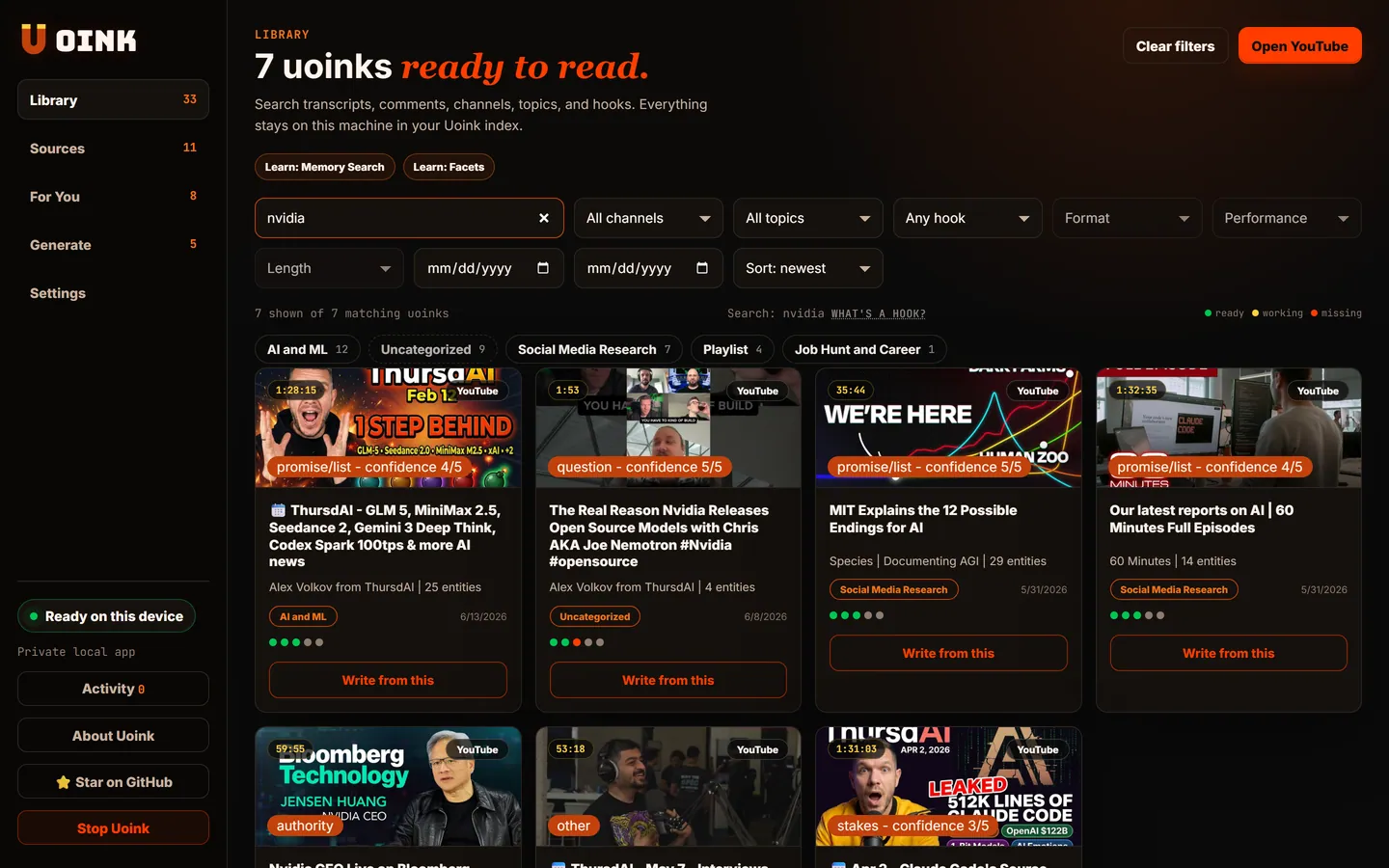
search_uoinks reaches: a local SQLite full-text index over every transcript, comment, and title on disk.Names stay visible. Details stay folded.
The manifest remains canonical for schemas. This page keeps the public tool names readable for humans, crawlers, and agents without turning the page into one endless list.
Start with uoink_video, search_uoinks, get_uoink_corpus, classify_hook, and find_mentions. Open a bucket when you need the rest.
Core stdio toolsThe core daily path for capture, search, comments, hooks, citations, and health.14 tools
Library, role, and live statusLocal reads and setup helpers that shape the library around the user's workflow.5 tools
Podcast and mobile bridgeRSS feeds, WhisperX checks, monitored playlists, and mobile save-to-playlist workflows.13 tools
Memory, facets, and workspace assemblyTaste memory, engagement signals, facet filters, workspace planning, and corpus critique.11 tools
Claims, scripts, and Writing StudioEvidence capture, script versions, shot lists, tweets, blogs, and voice anchors.16 tools
Universal page and thread capturePage and Reddit-thread capture plus allowed-site controls for the local helper.5 tools
Humans read this page. Agents read the manifest.
MCP page.
Human-readable server metadata, transport notes, config reminders, and tool list.
Open /mcp ->02Manifest JSON.
Machine-readable tool surface for agent crawlers and registry submissions.
Open JSON ->03llms.txt.
Short product summary, install links, source pages, and agent docs in crawler-friendly text.
Open llms.txt ->