Everything Uoink does.
Capture the source, build the library, assemble workspaces, verify claims, then hand the evidence to Claude, ChatGPT, Cursor, or an MCP agent.
Capture
Get source material into Uoink: YouTube pages, playlists, Shorts, podcasts, Twitter video, and approved web pages.
In-page Uoink button
Capture YouTube transcripts and frames directly from your browser.
Open feature -> shipped
Right-click context capture
Capture YouTube and X videos directly from link context menus.
Open feature ->shippedKeyboard capture shortcut
Trigger instant video extraction with customizable keyboard shortcuts.
Open feature ->Mobile playlist bridge
Save videos to a playlist named "uoink me" and let the desktop helper capture them.
Open feature ->Universal page extraction
Extract clean markdown and metadata from any web page using local Crawl4AI.
Open feature ->in flightX video transcripts
Extract transcripts and creator citations from videos on X.
Open feature ->
 shipped
Podcast RSS ingestion
Poll podcast RSS feeds and transcribe episodes locally using Whisper.
Open feature ->YouTube Shorts transcription
Capture and classify YouTube Shorts to analyze fast-paced video hooks.
Open feature ->Playlist queue extraction
Batch extract up to 10 YouTube videos at once with partial-failure tolerance.
Open feature ->Substack article extraction
Extract clean markdown texts and metadata from Substack newsletters.
Open feature ->LinkedIn video extraction
Extract clean transcriptions and metadata from LinkedIn videos into your local library.
Open feature ->Reddit thread extraction
Save structured text discussions from Reddit posts into your local library.
Open feature ->Bluesky and Mastodon thread capture
Capture structured social threads from Bluesky and Mastodon into your local database.
Open feature ->Library
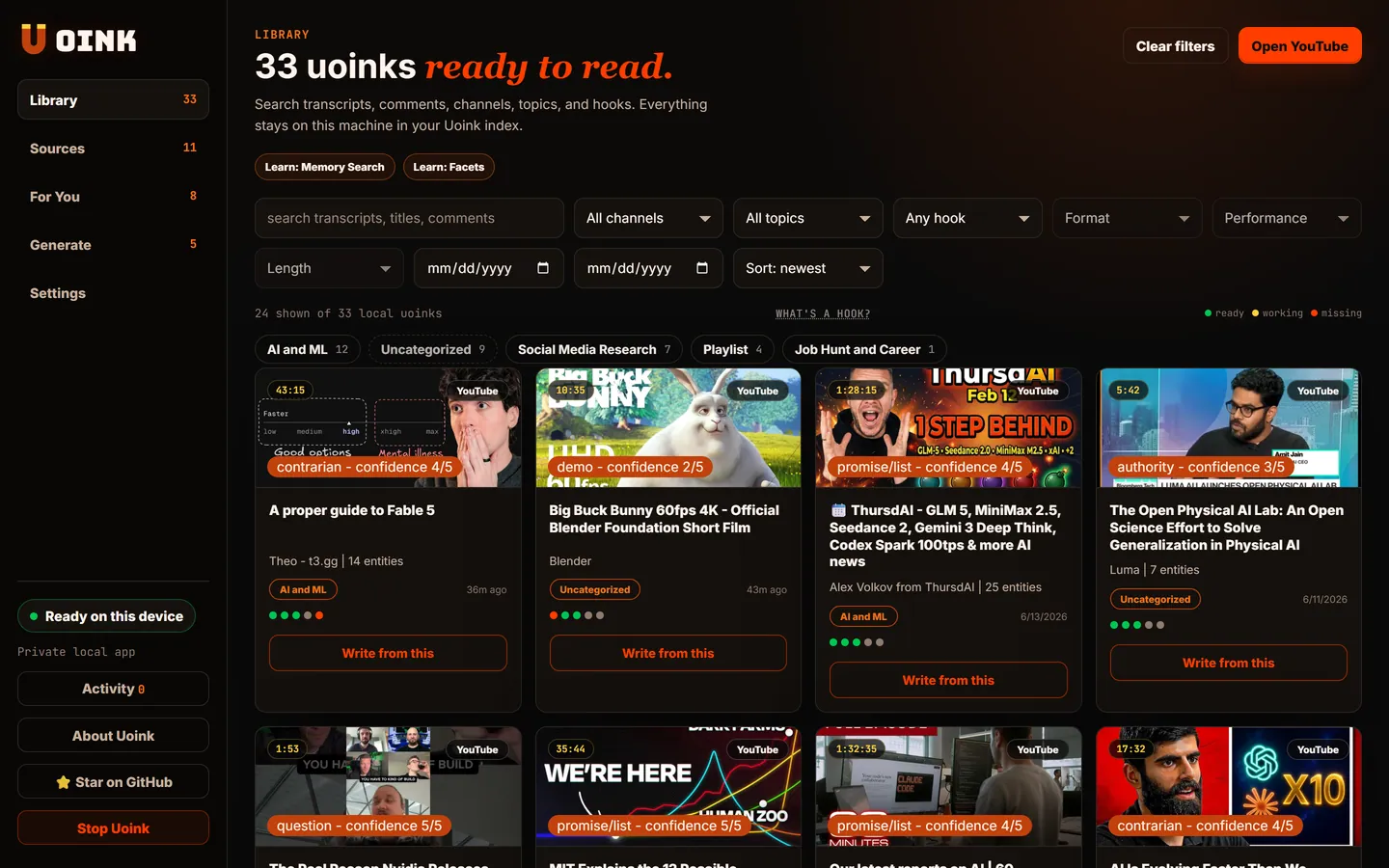
Turn captures into memory: search, facets, your channel, taste anchors, and resurfacing.
 shipped
Local SQLite FTS5 search
Search transcripts, comments, and metadata instantly using local SQLite full-text search.
Open feature ->shippedFacet and tag organization
Organize your video corpus using automatically generated topic folders, hook types, and creator tags.
Open feature ->Your channel mode
Configure your own YouTube channel to analyze hook performance and audience patterns.
Open feature ->plannedResurface for you
Discover forgotten insights in your video library with personalized local resurfacing cards.
Open feature ->plannedEngagement memory
Track which videos you reference most to build a durable local knowledge base.
Open feature ->in flightTaste anchors calibration
Calibrate your local memory layer by selecting reference videos that define your research taste.
Open feature ->Workspace
Assemble source sets, critique ideas against evidence, write scripts, and draft posts from the corpus.
in flightWorkspace assembly
Assemble a local markdown corpus from multiple video sources for a project workspace.
Open feature ->in flightCorpus analysis critique
Run structured critiques on your draft against a local video and article corpus.
Open feature ->in flightScript studio workspace
Generate, revise, and outline video scripts grounded in your local markdown corpus.
Open feature ->in flightWriting studio tool
Generate tweets, threads, and blog posts grounded in your captured video corpus.
Open feature ->Style anchor management
Import and manage style anchors from Substack or text to guide AI voice tone.
Open feature ->Verification
Extract claims and keep the evidence panel close so outputs stay grounded.
Distribution
Give Claude Desktop, Cursor, and other clients a local MCP path into your research library.
Model Context Protocol server
Turn Uoink into a local MCP server to give Claude and Cursor tools for video capture.
Open feature -> shipped
Claude Desktop MCP integration
Connect Uoink to Claude Desktop to let Claude capture and search video files.
Open feature -> shipped
Cursor MCP integration
Add Uoink to Cursor to search and reference your video corpus inside your editor.
Open feature ->Identity
Keep the trust layer visible: BYO keys, local-first processing, and no Uoink cloud.
shippedBring your own API key
Use your own Anthropic API key to run Hook Type and Comment Intelligence passes.
Open feature ->shippedLocal-first architecture
Save transcripts, comments, and databases to your local drive for private research.
Open feature ->shippedNo cloud database
Keep your video corpus and research private with no cloud databases or remote servers.
Open feature ->